
Which Gutter Guards for Pine Needles Work?
Pine needles are small, flexible, and persistent. They can settle into gutters, work through oversized openings, collect at downspouts, and form compact mats that keep water from moving where it should. For Black Hills property owners surrounded by evergreens, choosing gutter guards for pine needles is less about finding a maintenance-free product and more about building a drainage system that performs through wind, rain, snow, and seasonal debris.
A good guard can greatly reduce how often gutters need cleaning. The wrong one can create a new problem by trapping needles on top, slowing drainage during a hard rain, or making future service difficult. The right choice depends on your roof, gutter condition, tree coverage, and how water behaves around the building.
Why Pine Needles Are Hard on Gutters
Broad leaves tend to sit on top of a gutter guard until the wind carries them away or they dry out. Pine needles behave differently. They can slip into larger openings, weave through brush-style inserts, and cling to wet surfaces in tight clusters. Once mixed with shingle grit, seed pods, and roof debris, they can create a dense blockage that is harder to remove than ordinary leaves.
In Rapid City and across the Black Hills, wind adds another factor. Needles may gather in one corner of a roof valley or pile against a gutter run after a single storm. Winter conditions matter, too. When gutters are already holding debris or standing water, freeze-thaw cycles can add weight and stress to the gutter system, fascia, and fasteners.
That is why a guard should be evaluated as part of the complete drainage system. A clean-looking guard does not help much if water cannot enter quickly enough or if the downspouts are undersized, loose, or clogged below the surface.
The Best Gutter Guards for Pine Needles Usually Use Fine Mesh
For most homes with heavy pine coverage, a properly installed fine micro-mesh guard is often the strongest option. Its small openings are designed to let water pass while keeping pine needles, shingle granules, and other fine debris above the gutter. With the right pitch and a solid frame, much of that debris can dry and blow away over time.
Fine mesh is not automatically the best fit for every property. Water needs to flow off the roof and through the mesh without overshooting the gutter. Roof pitch, valley placement, gutter size, and local rainfall all affect performance. Installation details are just as important as the product itself. A guard that sits too high, pulls loose, or interferes with shingles can lead to drainage issues and create unnecessary roof concerns.
A quality installation should leave the system secure, accessible for future service, and properly matched to the gutter line. If a gutter is sagging, improperly sloped, or separating from the fascia, installing guards first may only hide a problem that needs repair.
Surface-Tension Guards Can Work, With the Right Roof Setup
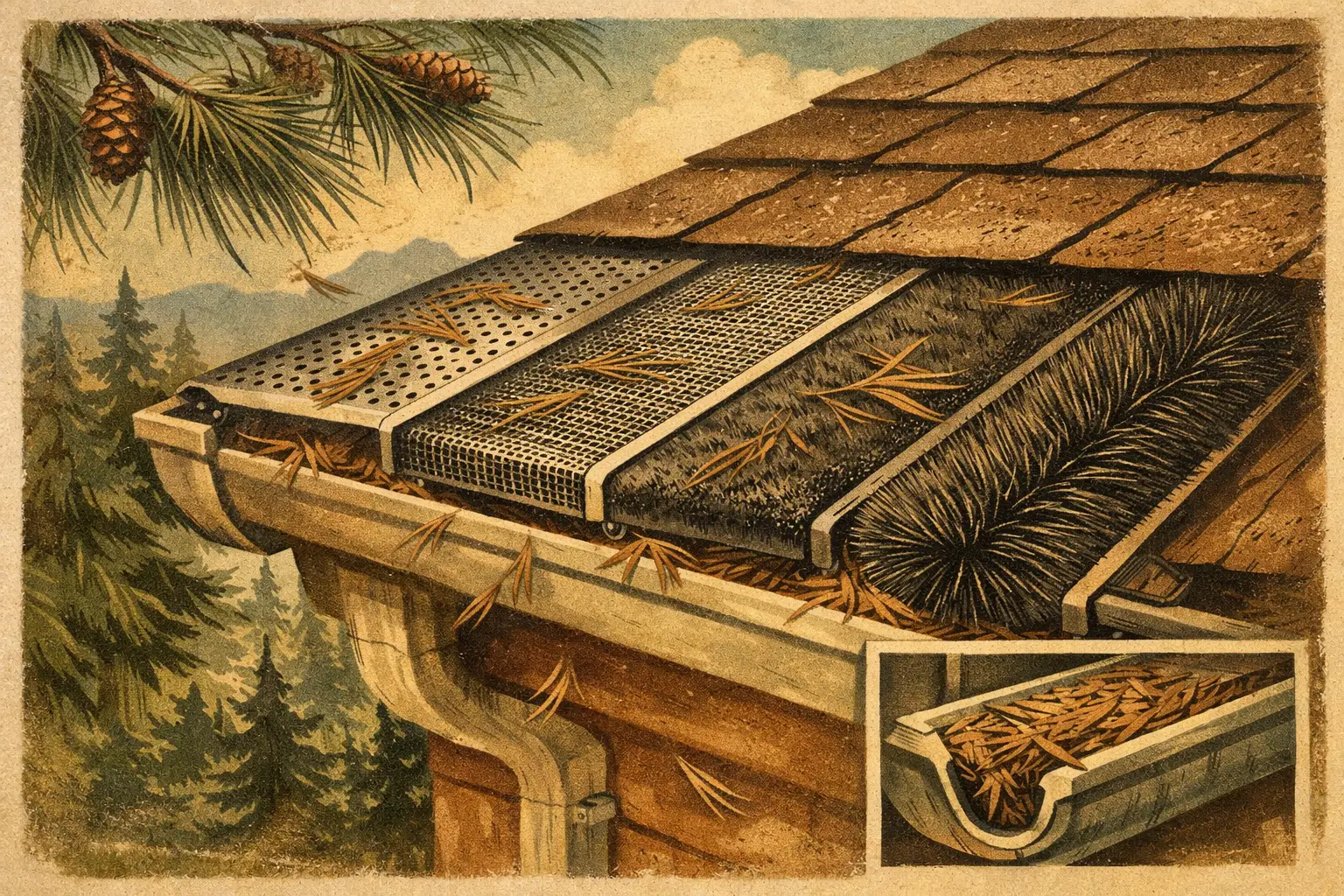
Surface-tension or reverse-curve guards use a shaped cover that directs water around a front edge and into the gutter. They can shed larger debris well, but pine needles may collect along the edge or sit in areas that need occasional brushing. Their performance can also vary based on roof pitch and the volume of water coming off the roof.
These systems can be effective on the right home, especially when professionally fitted. They are not a one-size-fits-all answer for every pine-heavy lot. Before selecting this style, property owners should ask how the guard handles roof valleys, fast-moving runoff, and the specific needles found around the building.
Screens, Foam, and Brush Inserts Have Clear Trade-Offs
Standard perforated screens are often less expensive and may keep out larger debris, but many have openings large enough for pine needles to enter. They can still be useful where tree coverage is light, yet they are rarely the first choice for a home beneath mature pines.
Foam and brush inserts sit inside the gutter rather than covering it. They may stop large leaves from filling the channel, but pine needles can become embedded in the material. Over time, trapped organic debris can hold moisture and make cleaning more involved. These products may be appropriate as a short-term or budget-focused option, but they should not be treated as a permanent solution in a high-needle environment.
What to Check Before Installing Gutter Guards
The condition of the existing gutter system should guide the decision. Guards work best on gutters that are correctly pitched, firmly fastened, and large enough to handle runoff from the roof. If water already spills over the front edge during rain, guards alone will not correct the issue.
A professional inspection should look at the roof edge, fascia, flashing, gutter slope, seams, hangers, and downspout locations. It should also identify roof valleys that discharge large volumes of water into short sections of gutter. These areas may need larger gutters, additional downspouts, or other drainage improvements before guards are added.
For commercial buildings, the same principles apply, but roof area and drainage volume make the stakes higher. A blocked downspout can send water toward entrances, loading areas, foundations, or walkways. Property managers should consider guard selection alongside routine maintenance plans and safe access for future inspections.
Installation Details Matter More Than the Sales Pitch
No gutter guard is truly maintenance-free. Even fine mesh systems need periodic checks, particularly after heavy wind, spring pollen, or a season of falling needles. The goal is to reduce debris inside the gutter and make maintenance less frequent, safer, and more manageable.
A dependable installation begins with cleaning and repairing the gutters before guards go on. The installer should confirm that downspouts are open, seal leaking joints, secure loose sections, and correct obvious pitch issues. Guards should fit tightly without lifting at the edges or creating gaps where needles can enter.
Be cautious of any recommendation that promises a product will never need attention again. A straight answer is more valuable: the best system will keep most pine needles out of the gutter, but debris can still collect on top of the guard, especially near valleys and under dense trees. Occasional inspection protects the investment.
Choosing a Guard for Black Hills Weather
Local weather should be part of the conversation. Strong winds can blow debris under poorly fitted guards. Heavy snow and ice can expose weak gutter fasteners or guards that are not firmly attached. Sudden rain can test whether the system moves water fast enough during peak runoff.
For that reason, homeowners should prioritize durable materials, secure attachment methods, and a gutter system sized for the roof rather than choosing solely on the lowest price. Aluminum micro-mesh systems with a strong frame are a common fit for many properties, but the right recommendation should follow an inspection rather than a guess from the ground.
It also helps to look beyond the gutter itself. Overhanging limbs can increase needle buildup and scrape against roofing during wind. Trimming branches back where appropriate, keeping roof valleys clear, and making sure downspout discharge moves water away from the foundation all support better drainage.
When Gutter Guards May Not Be the First Fix
If gutters are overflowing because they are too small, poorly sloped, or damaged, replacement or repair should come before guards. The same is true when water is backing up under roof edges, fascia boards show rot, or downspouts repeatedly clog. A guard is a protective addition, not a substitute for a sound gutter system.
For some properties, scheduled cleaning may remain the practical choice. A lightly wooded home with easy one-story access may not need a premium guard system. A steep two-story home surrounded by pine trees is a different situation, where reducing repeated ladder work and debris buildup may offer stronger long-term value.
Good Guys Exteriors approaches gutters as part of the property’s full exterior protection system. A careful assessment can identify whether pine needles are the main issue or whether roof runoff, gutter condition, and drainage layout also need attention.
The best next step is to choose a solution that fits the building you own, not a broad promise on a box. When gutters are sound, guards are properly matched, and the system receives occasional care, pine needles become a manageable maintenance concern instead of a recurring threat to your roofline, siding, and foundation.